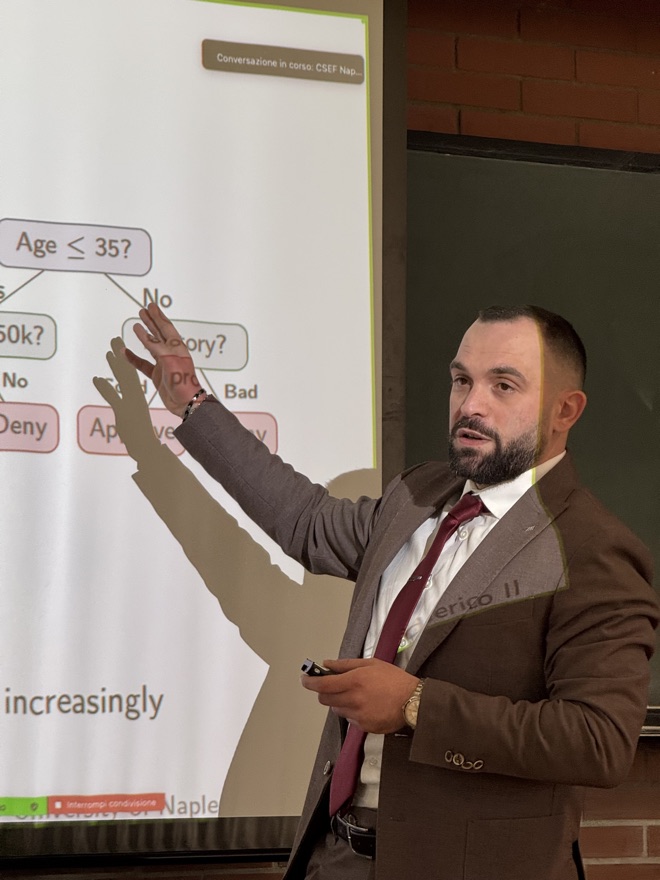
e2tree is built by researchers at the University of Naples Federico II and K-Synth. The goal: make ensemble models auditable without sacrificing accuracy.
Host institution
University of Naples Federico II
Spin-off
K-Synth Naples, Italy
The team
Creators & contributors.
Creators
Authors of the e2tree method and maintainers of the R package.
Massimo Aria
Full Professor of Statistics for Social Sciences University of Naples Federico II · K-Synth
Agostino Gnasso
Researcher in Statistics University of Naples Federico II · K-Synth
Carmela Iorio
Associate Professor of Statistics University of Naples Federico II
Contributors
Co-authors on the papers that introduced and extended the method.
Giuseppe Pandolfo
Assistant Professor of Statistics University of Naples Federico II
Co-author on the original classification method (2024 Computational Statistics paper)
Marjolein Fokkema
Associate Professor of Methodology and Statistics Leiden University, Netherlands
Co-author on the regression extension (2026 ASMBI paper)
Publications
The papers.
Three papers describe the method. The first covers classification, the second extends it to regression, and the third builds the statistical framework for measuring how faithfully the tree reconstructs its ensemble.
Introduces the algorithm for classification. Defines the co-occurrence dissimilarity framework and the recursive tree-growing procedure, benchmarked on real datasets. The single e2tree matches Random Forest accuracy and is readable.
Extending Explainable Ensemble Trees to Regression Contexts
Aria, M., Gnasso, A., Iorio, C., & Fokkema, M.
Extends the method to regression. Co-occurrence weighting is adapted to account for response similarity between pairs, with a new impurity measure for continuous targets. Benchmarked against CART and GUIDE.
regressioncontinuous responseXAI
BibTeX
@article{aria2026e2tree_reg,
title = {Extending Explainable Ensemble Trees to Regression Contexts},
author = {Aria, Massimo and Gnasso, Agostino and Iorio, Carmela and Fokkema, Marjolein},
journal = {Applied Stochastic Models in Business and Industry},
volume = {42},
number = {1},
pages = {e70064},
year = {2026},
doi = {10.1002/asmb.70064}
}
CSDA · Under review
A Family of Divergence Measures for Evaluating the Reconstruction Quality of Explainable Ensemble Trees
Aria, M., Gnasso, A., & Iorio, C.
Validating a surrogate requires measuring agreement with the ensemble's internal representation, not mere association. This paper introduces the normalized Loss of Interpretability (nLoI), a robustified Neyman-type statistic sitting in the Cressie–Read power divergence family at λ = −2, whose closed-form decomposition into within- and between-node components identifies precisely where and why reconstruction fails. Four complementary measures — Hellinger, wRMSE, RV coefficient and SSIM — and a unified permutation testing procedure complete the toolkit.